
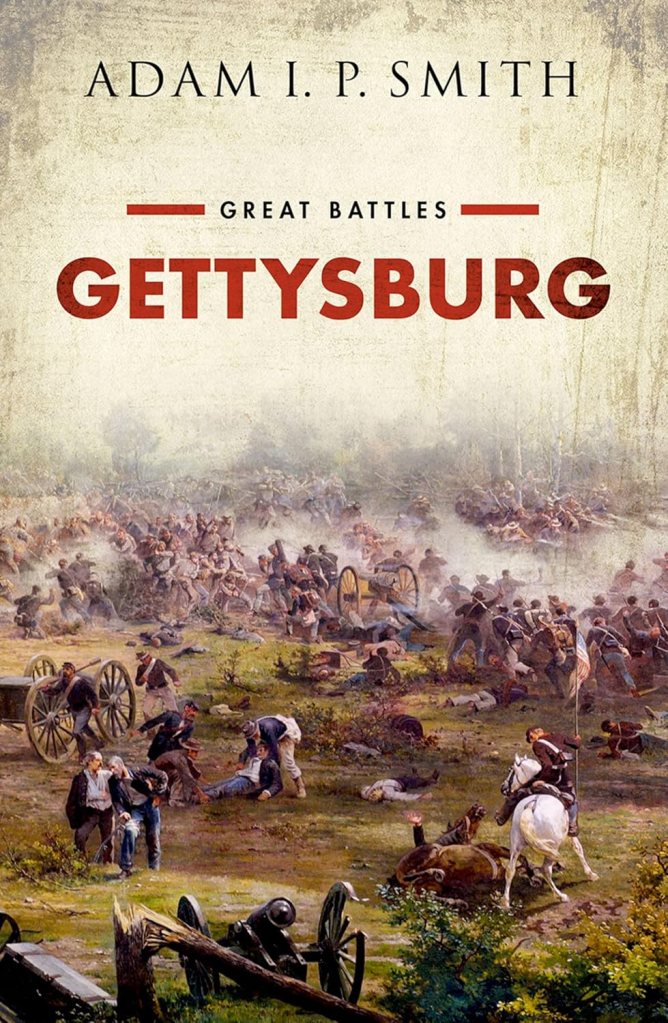
I am delighted to announce that my latest book has just been published by Oxford University Press. You can buy a copy here.
Here are the opening pages:
As soon as the guns had fallen silent on July 3, 1863, Gettysburg became a place of the imagination. The three-day battle fought across the gentle ridges around the small Pennsylvania town was the bloodiest encounter of the American Civil War. Farmers and bounty hunters uncovered human remains in the fields for years afterwards. Even today, you can still find bullets.
But it was not only the scale of the violence that bestowed upon this battle a sacred place in American national mythology. The stories told about Gettysburg are the stories of America itself, more intensely so than other hallowed places in the American story, including even the places where the Revolution was fought, or the Constitution was written. The essence of the Gettysburg myth is that here the fate of the republic was determined; here that America was re-consecrated.
Gettysburg has been a vacation resort, a war grave, and a public park, and, more than that, it has become a shrine. Over a century and a half, pilgrims have come to Gettysburg in their millions to remember the dead but also to feel connected to some essential quality of the American experiment. Even those who came to have a good day out were also constructing memories and meaning.
If, like countless visitors before, you stand on Cemetery Ridge, perhaps in the fading light of a summer evening, you will see a blue-tinged range of hills on the western horizon. In front of you, the fields slope gently away towards a road and then rise again to a wooded ridge about a mile in front. In 1964, the writer Norman Cousins went to Gettysburg to interview former president Dwight Eisenhower, who had retired to a farm on the battlefield. “It is difficult,” Cousins wrote, “for the mind to sustain the thought that these quiet fields were once the setting for one of the most violent encounters in history. The blood in the earth runs deep at Gettysburg, but the eye sees only an enchanted land.” Blood and soil: the vital nationalist ingredients of sacred ground. The land is enchanted not just by the beauty of the countryside but by the enchantments of meaning imposed on the field by those who fought there and those who have come after.
Why Gettysburg and not some other battle at some other time? When and why did this happen? The simple answer to the when question is Independence Day, July 4, 1863. It was then that it became clear that the battle was over, and the Union Army of the Potomac was victorious. The Confederate Army of Northern Virginia had run out of options after the repulse of Pickett’s Charge on July 3. This was the massive frontal assault on the Union line by around twelve thousand soldiers under the command of three Confederate generals, one of whom was George Pickett. It is a familiar story and one which echoes that of so many other “heroic” failed attacks against well-entrenched defenders, from the charge of the Light Brigade at Balaklava to the ranks of British soldiers advancing towards German machine guns on the first day of the Somme. Having suffered around 30 per cent casualties, any hope of advancing on Baltimore or Washington extinguished, Lee’s army began the hazardous business of retreating south, across the flood-swollen Potomac River and back into Virginia. In the following decades, veterans relitigated every tactical and strategic decision in print, in testimony to Congressional hearings, and in valedictory speeches.
The main aim of this book is to offer some answers to the why question. In the Gettysburg Address, Abraham Lincoln summed up American exceptionalism: the idea that the United States had a Providential mission to preserve free government everywhere on earth. Similarly, there is also a Gettysburg exceptionalism: the idea that the bloody struggle in those Pennsylvania fields was both different from all other battles while also of universal significance. Gettysburg was the only big battle of the Civil War fought on free soil (Antietam, in September 1862, was fought in a loyal state, but one in which slavery remained legal). People’s perception at the time in both North and South was that this mattered greatly. It was one thing for the Union army to invade the South; it was quite another for the rebels to strike into the heart of the free North. Gettysburg became the turning point of turning points, the moment when all was lost and all won. It was the Civil War in miniature: a glorious, storied, tragic tale that was small enough to comprehend but large enough to be inspirational. For all its complexity, understanding Gettysburg was easier than understanding the whole war—or so it seemed. Many people laboured to define what Gettysburg meant, from the town boosters who wanted tourist dollars, the veterans in blue and gray (who often warred among themselves more than with their erstwhile enemies), to self-appointed custodians of the battlefield such as the various agencies of the Federal government and generations of historians, journalists and battlefield guides. The story of how and why Gettysburg has come to matter so much – why it has become an American “shrine” – is a story of many hands, and it has kept rolling on from that Independence Day in 1863 down to the latest generation.
 Adam Smith: Historian