History
-
This article appeared in The Sunday Times July 3, 2023 The US Supreme Court’s ruling on Thursday that race-based affirmative action in university admissions is unconstitutional marks the end of an era. For half a century, the court has upheld the right of educational institutions — and by implication also employers — to factor race…
-
This article appeared in The Sunday Times August 26, 2023 Freedom was in the air at the Republican presidential candidates’ debate last week. The former vice-president Mike Pence said that “America needs to stand for freedom”; the governor of North Dakota, Doug Burgum, said that “we need to get back to freedom”; and the businessman…
-

This is my inaugural lecture as the Edward Orsborn Professor of US Politics and Political History, delivered in the Exam Schools in Oxford on April 25, 2022. The American Civil War as a Conservative Revolution Vice Chancellor, Ladies and Gentlemen. Thank you all so much for taking the trouble to be here this afternoon. As…
-

This is a piece I wrote for BBC History Magazine on January 15, 2021 Before Trump, no US President has incited a mob in the hope of disrupting the legislature from ratifying his election loss. Yet when a chorus of commentators repeated “this is not who we are” as they watched footage of Trump supporters…
-
I wrote the following piece for the January 2021 issue of BBC History Magazine. On the fourth of March, 1801, in the city of Washington — then just a half-built, muddy encampment on the banks of the Potomac – a living Head of State peacefully gave up power and a new one took over. The…
-
This is a review I wrote for the Journal of the Early Republic of “There is a North”: Fugitive Slaves, Political Crisis, and Cultural Transformation in the Coming of the Civil War. By John L. Brooke The premise of this important book is that to understand the coming of the civil war we need to…
-
This is a piece I wrote for The Journal of the Abraham Lincoln Association which was published in their Summer 2020 issue. They slightly edited it. This is the full version. Review of Greg Weiner, Old Whigs: Burke, Lincoln & the Politics of Prudence Greg Weiner thinks that Lincoln was a Burkean. There are good…
-
This is a piece I wrote on January 22, 2019, for BBC History Magazine about the history of US Federal government ‘shutdowns’. The context was the longest shutdown (to that point) in history that had resulted from President Trump’s demand that Congress give him Like so much else, it’s all the fault of the Founding…
-
This is a review I published in History Today of Jill Lepore’s fabulous book, These Truths One of the ways in which the current President of the United States differs from all his predecessors, from Washington to Obama, is that unlike them he doesn’t speak of the special mission of his country. When he talks…
-

The first time I visited the American South, sometime in the late 1990s, I took at tour around one of those elegant plantation houses–I think it was in South Carolina–with a Spanish moss-covered avenue of trees, a shaded veranda on which to sip one’s mint julep, and discretely placed slave quarters. The lady showing us…
-
A few days ago President Trump’s Chief of Staff John Kelly told Fox News that the Civil War was caused by the “lack of an ability to compromise”, that it was “fought by men and women of good faith on both sides” and that General Robert E. Lee was an “honorable man.” Frankly, it would…
-

A hundred years after the US declared war on Germany, I was at the main US military cemetery at Romagne-sous-Montfaucon and there was absolutely no one there at all other than me, the battlefield historian I was interviewing and my radio producer. This is a very empty part of France. You can drive for miles…
-

Among Donald Trump’s accomplishments is inadvertently stimulating popular interest in epistemology. “Post-truth” is the Oxford English Dictionary’s 2016 “word of the year”—a judgment based largely on the number of times it’s been invoked by journalists discussing the politics of the UK European referendum and the US presidential election. In a post-truth world, politics is conducted…
-
On election night last Tuesday, I was in New York. I watched Trump’s victory speech in a Sky News studio where I’d been offering some occasional undigested thoughts. A little later, when I emerged into Time Square in a dank pre-dawn hour, drunk Trump supporters were chanting “lock her up” and “build the wall”. One…
-
A version of this blogpost appeared in the November 2016 edition of BBC History Magazine. It accompanies my BBC Radio 4 series, The Robber Barons. Railroad bosses were not supposed to order their own freight cars to be burned. In 1859, however, the superintendent of the western division of the Pennsylvania Railroad – a 24-year…
-
Whenever the French have had a revolution since the first great eruption of 1789, they’ve re-written their Constitution and started over again — so the current French state is the Fifth Republic. Over the same period, in contrast, the USA appears to have had one stable Constitutional order. But appearances can be deceptive. Beneath the…
-

In the last twelve months we have lost two great historians of the United States: William Brock and Michael O’Brien.* I remember them both with admiration and affection. They were men of different temperaments, backgrounds and generations, but beneath the surface were some similarities that tell us much about the practice of history at its…
-
It’s not surprising that its residents so readily describe Santa Barbara as paradise. On a fertile plain between steeply rising mountains and a sandy, south-facing stretch of the California coast, the city basks in year-round warm sunshine. I was there at the end of January, when the contrast with the wintry chill of London was…
-
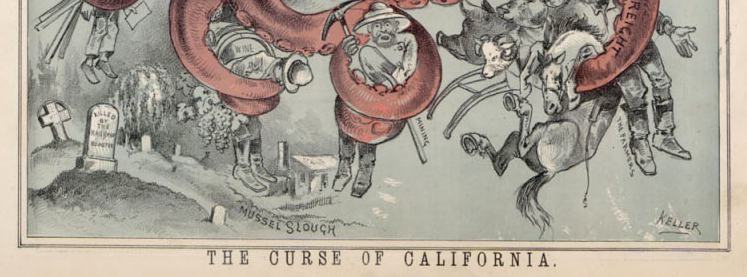
A few weeks ago I found myself in the middle of California’s central valley, standing on the edge of a road with straight lines of fruit trees stretching regimentally in every direction. It is a totally flat landscape – more like the Midwest than most people’s image of California. On a clear day I probably…
-

A frontier gunfight May 11, 1880: a gunfight in a wheat field six miles northwest of Hanford, CA, the main town in what was then known as the Mussel Slough area of Tulare County (now Kings County) in the Central Valley. Seven men were killed or mortally wounded that day. The fight was over land.…
 Adam Smith: Historian