
Gettysburg (Oxford University Press, 2025)
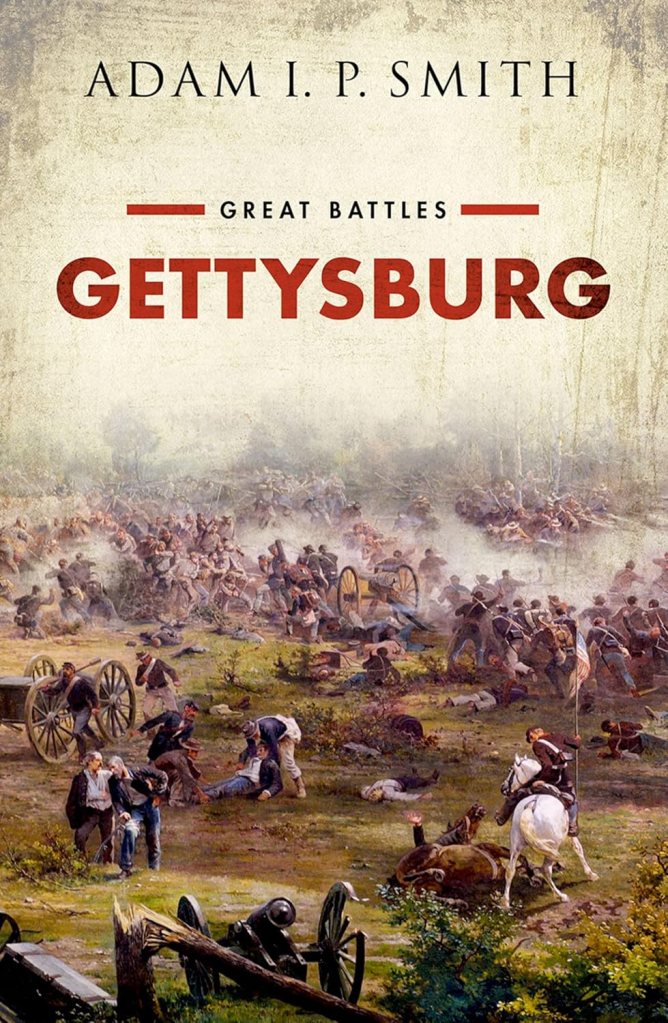
How did Gettysburg become the most famous battle of the American Civil War and one of the most consequential in world history? Why is the most visited battlefield, the place where veterans came in the greatest numbers, where Presidents pay homage, and millions of families have vacationed? What was it about this three-day struggle in July 1863 in the rolling hills of Pennsylvania that made it seem the “turning point of the war”, or the “high-water mark” of the Confederate rebellion?
Gettysburg explains the battle’s place in the Civil War, why two vast armies clashed there, and how, in the century and a half since, it has been re-imagined, re-created and re-enacted. It is the story of a battle which no one planned but which became the bloodiest encounter of the war, and one with dramatically high stakes. The postwar romanticisation of Gettysburg as the place of “might-have-beens” is based on a kernel of reality.
But it also suited the interests of both the winners and the losers for Gettysburg to become the Civil War in miniature: a glorious, storied, tragic tale small enough to comprehend, but large enough to be inspirational. If this was the battle that determined the war, Confederates could tell themselves that if only they had made different tactical choices, they would have won their independence, while Northerners could credit valour for their victory, without the unromantic need to invoke superior resources.
Yet there was only a war because of slavery, and Gettysburg’s importance lies in its role in ending it. In the speech Abraham Lincoln gave there, four months after the battle, he expressed the hope that Union victory would inaugurate a “new birth of freedom”. The history of the battle has been shaped by a contest over what that means.
REVIEWS:
“Here is a splendid first book to read about Gettysburg. Adam I. P. Smith places the battle within its broader wartime context, clearly narrates its tactical ebb and flow, and, most valuably, assesses its powerful influence on popular understanding of the nation’s most disruptive and transformational moment.’” – Gary W. Gallagher, John L. Nau III Professor of History Emeritus, University of Virginia
“‘In this lucid, learned book, Adam I.P. Smith has captured the emotional power of Gettysburg as both a place and an idea. The epic clash symbolized the triumph of freedom for Unionists and the allure of “what ifs” for Confederates. Over time, Gettysburg became a test of Americans’ capacity for forgiveness and a testament to the “endurance of the ideal of heroic warfare.” Smith deftly conveys the drama and contingency of the battle itself and of the battle of the imagination, over Civil War memory, that still rages on.’” – Elizabeth R. Varon, author of Longstreet: The Confederate General Who Defied the South
“In eloquent prose, Smith weaves stories large and small into a sweeping narrative that explains why Gettysburg has loomed so large in the national imagination since those fateful days in July 1863. This volume is destined to become the first place anyone turns to understand the coming, fighting, aftermath, and memory of America’s most well-known battle and town.” – Caroline E. Janney, Author of Ends of War: The Unfinished Fight of Lee’s Army after Appomattox
The Stormy Present: Conservatism and the Problem of Slavery in Northern Politics, 1848-1865 (University of North Carolina Press, 2017)
WINNER OF THE AMERICAN CIVIL WAR MUSEUM’S JEFFERSON DAVIS BOOK PRIZE 2018
FINALIST FOR THE GILDER LEHRMAN LINCOLN PRIZE 2018
In this engaging and nuanced political history of Northern communities in the Civil War era, Adam I.P. Smith offers a new interpretation of the familiar story of the path to war and ultimate victory. Smith looks beyond the political divisions between abolitionist Republicans and Copperhead Democrats to consider the everyday conservativism that characterized the majority of Northern voters. A sense of ongoing crisis in these Northern states created anxiety and instability, which manifested in a range of social and political tensions in individual communities.
In the face of such realities, Smith argues that a conservative impulse was more than just a historical or nostalgic tendency; it was fundamental to charting a path to the future. At stake for Northerners was their conception of the Union as the vanguard in a global struggle between democracy and despotism, and their ability to navigate their freedoms through the stormy waters of modernity. As a result, the language of conservatism was peculiarly, and revealingly, prominent and telling in Northern politics during these years. The story this book tells is of conservative people coming, in the end, to accept radical change.
“This brilliant, timely, and original book is a ‘must-read’ for specialists and scholars of nineteenth-century U.S. History and American politics. Among his many contributions, Smith finds the sensible middle ground between conflicting interpretations of whether the Civil War was a war for abolition or for Union.” -Elizabeth R. Varon, University of Virginia
“The Stormy Present accomplishes the rare and therefore vital task of presenting a narrative of the late antebellum sectional crisis that shows how sectionalist radicals drove events but conservatives and conservatism were also a force to be reckoned with. Smith’s is a precise, rich exploration of what conservatism meant to a wide range of Northerners that those subjects themselves would recognize, painting a nuanced portrait of both change and continuity in this era.” -Matthew Mason, Brigham Young University
Abraham Lincoln
The History Press (2014)
The President who ‘freed’ the slaves and held the Union together in the face of the slaveholding South’s bid to create a separate Confederacy. The teller of ribald stories, and the author of the most sublime speeches in the English language. A clever, complex, secretive man who rose from frontier obscurity to become the central figure at the moment when the United States of America came close to disintegration. Was Lincoln the ‘Great Emancipator’, whose wartime leadership helped free four million enslaved people? Or was he a nationalist who jumped late on the antislavery bandwagon? Was his intransigence the cause of much bloodshed? Or was he a pragmatist whose leadership minimised the destruction of the war? This concise biography situates Lincoln in his time and place. A very human figure who, after his assassination by a leading Shakespearean actor, was turned into an icon.
The American Civil War
Palgrave (2007)
The American Civil War was by far the bloodiest conflict in American history. Arising out of a political crisis over the expansion of slavery, the war set the stage for the emergence of the modern American nation-state. This new interpretation of one of the most mythologized events in modern history combines narrative with analysis and an up-to-date assessment of the state of Civil War scholarship.
No Party Now: Politics in the Civil War North
Oxford University Press (2007)
During the Civil War, Northerners fought each other in elections with almost as much zeal as they fought Southern rebels on the battlefield. Yet politicians and voters alike claimed that partisanship was dangerous in a time of national crisis.
In No Party Now, Adam I. P. Smith challenges the prevailing view that political processes in the North somehow helped the Union be more stable and effective in the war. Instead, Smith argues, early efforts to suspend party politics collapsed in the face of divisions over slavery and the purpose of the war. At the same time, new contexts for political mobilization, such as the army and the avowedly non-partisan Union Leagues, undermined conventional partisan practices. The administration’s supporters soon used the power of anti-party discourse to their advantage by connecting their own antislavery arguments to a powerful nationalist ideology. By the time of the 1864 election they sought to de-legitimize partisan opposition with slogans like “No Party Now But All For Our Country!”
No Party Now offers a reinterpretation of Northern wartime politics that challenges the “party period paradigm” in American political history and reveals the many ways in which the unique circumstances of war altered the political calculations and behavior of politicians and voters alike. As Smith shows, beneath the superficial unity lay profound differences about the implications of the war for the kind of nation that the United States was to become.
 Adam Smith: Historian